
In the earliest myths, punishment descended from the heavens. The defiant were struck down, chained, or condemned to eternal repetition: Prometheus bound for stealing fire; Sisyphus condemned to his ceaseless ascent; Tantalus forever reaching for what retreats. These figures embodied divine justice as spectacle and punishment as something done tothe transgressor by cosmic authority. Then, philosophers started to reframe mythic punishment as psychological disequilibrium wherein vice is a pathology of the soul. They began to reinterpret these myths allegories of inner disorder rather than literal accounts of divine wrath. Iniquity was likened to fracture one’s own being, falling out of harmony with reason, truth, and the order of things.

Plato reinterpreted torment as the consequence of an imbalanced soul. In the Republic and Gorgias, wrongdoing became its own affliction because vice disfigured the psyche long before any external penalty was imposed. The soul itself became the theatre of justice. Socrates’ claim that “it is better to suffer injustice than to commit it” redefined the moral cosmos, turning vice from an external offense into a pathology of the soul. Later, the Stoics developed this into a moral psychology. They saw anger, greed, and fear as symptoms of a diseased spirit rather than offenses that required divine punishment. Early Christian thinkers like Augustine expanded on this by defining sin as a “privation of good” and inner exile from God, a self-inflicted hell. By the Enlightenment and beyond, philosophers—from Spinoza to Nietzsche—had secularized this insight. Punishment emerged from within, as guilt, alienation, or disintegration of self. Once punishment was understood as internal imbalance, the focus shifted from appeasing divine authority to restoring psychological and ethical equilibrium. Myths of endless toil and frustration served as metaphors for the restless mind caught in its own contradictions and for the regretful nature of evil. Injustice became its own prison, hubris its own chain—and this inward turn still shapes modern storytelling where moral conflict often plays out as a crisis within.
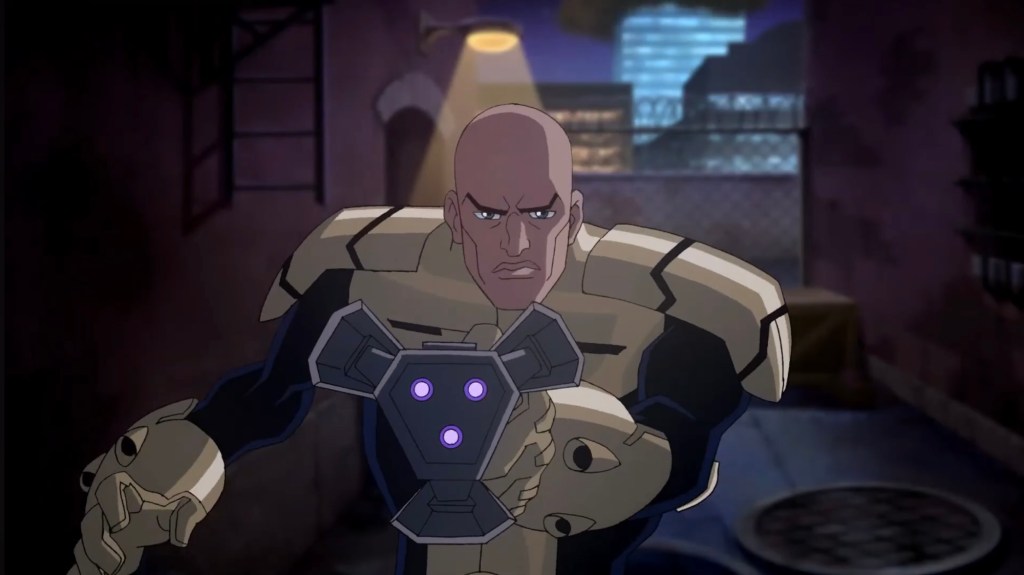
Justice League: Crisis on Two Earths (2010) externalizes that tension through parallel worlds of virtue and corruption, continuing a tradition that began in ancient Greece: the recognition that every cosmic struggle is also psychological; that the conflict between good and evil lies within the divided human soul. The story unfolds across parallel universes. In one world—our world—the familiar Justice League exists as heroes: Superman (Mark Harmon), Batman (William Baldwin), Wonder Woman (Vanessa Marshall), Green Lantern (Nolan North), J’onn J’onzz (also known as “Martian Manhunter,” voiced by Jonathan Adams), and The Flash (Josh Keaton)—while in another, an evil counterpart dominates the planet through corruption and fear. They call themselves the Crime Syndicate, led by Ultraman (Brian Bloom), Owlman (James Woods), Superwoman (Gina Torres), Power Ring (also Nolan North), J’edd J’arkus,and Johnny Quick (James Patrick Stewart). From the alternate Earth, Lex Luthor (Chris Noth) escapes to our Earth to seek help from the Justice League. As the last surviving resister, Luthor hopes they can help overthrow the tyranny. The Justice League clash with their villainous doppelgängers in efforts to dismantle the Syndicate’s global control. However, a deeper conflict centres on Owlman whose nihilistic worldview leads him to a plan that transcends ordinary evil. Believing that existence itself is meaningless due to the infinite number of parallel worlds, he steals a quantum weapon to destroy Earth Prime, the original world from which all others diverged; and thus resolves to erase the multiverse entirely.

To me, Owlman’s despair completes the philosophical descent from divine punishment to self-annihilation. Once evil is no longer punished by gods but corrodes the self from within, nihilism becomes its purest expression; the soul that, unable to reconcile meaning with multiplicity, seeks to end meaning altogether. His desire to destroy Earth Prime is the metaphysical equivalent of the tormented psyche longing for silence, like a Promethean intellect turning its fire against creation itself. In him, punishment and vice collapse into one act as the punishment he inflicts upon the cosmos is the punishment he unconsciously desires for himself—which is why he ultimately chooses to perish.
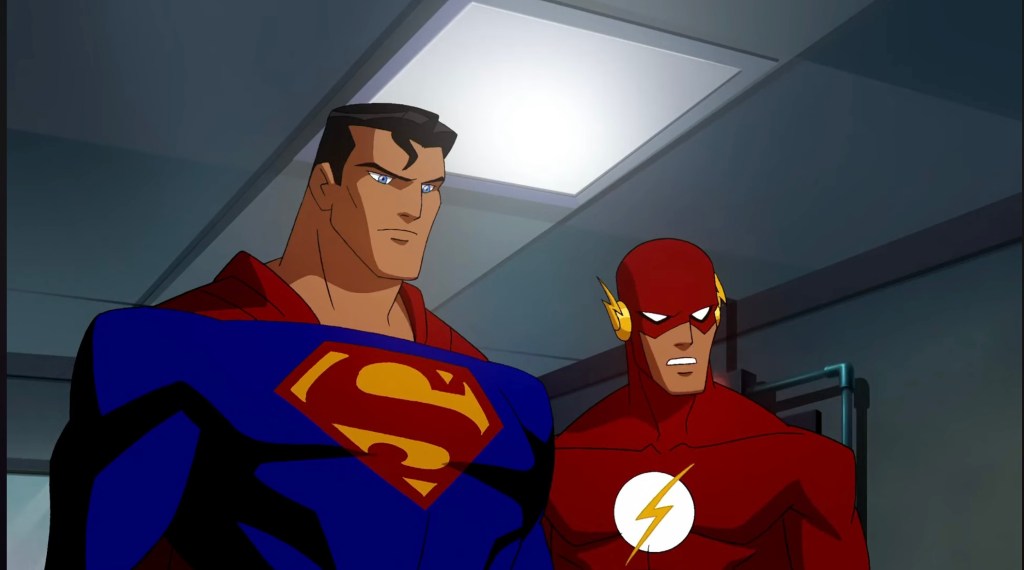
Then, there’s Ultraman whose menace lies in his utter normalization of cruelty. He rules through the exhibition of impunity and personifies as brute authority as the inverse of Superman’s moral ideal. He’s power without principle, strength ungoverned by empathy. His tyranny is more performative than abstract as he reminds the President (an alternate version of Deathstroke voiced by Bruce Davison) that the Syndicate murdered the First Lady during a failed assassination attempt and suffered no consequences; a declaration meant not merely to terrorize but to prove that might is immune to justice. Where Owlman’s evil is reflective, seeking meaning in annihilation, Ultraman’s is instinctive as the latter’s creed is that power justifies itself. For me, he illustrates the fulfillment of what philosophers once feared when virtue ceased to be cosmic law; that strength, unmoored from moral order, would crown itself as the only truth. In him, punishment no longer descends from heaven or arises from conscience; it becomes a spectacle of dominance, a demonstration that there is no higher court than force itself.
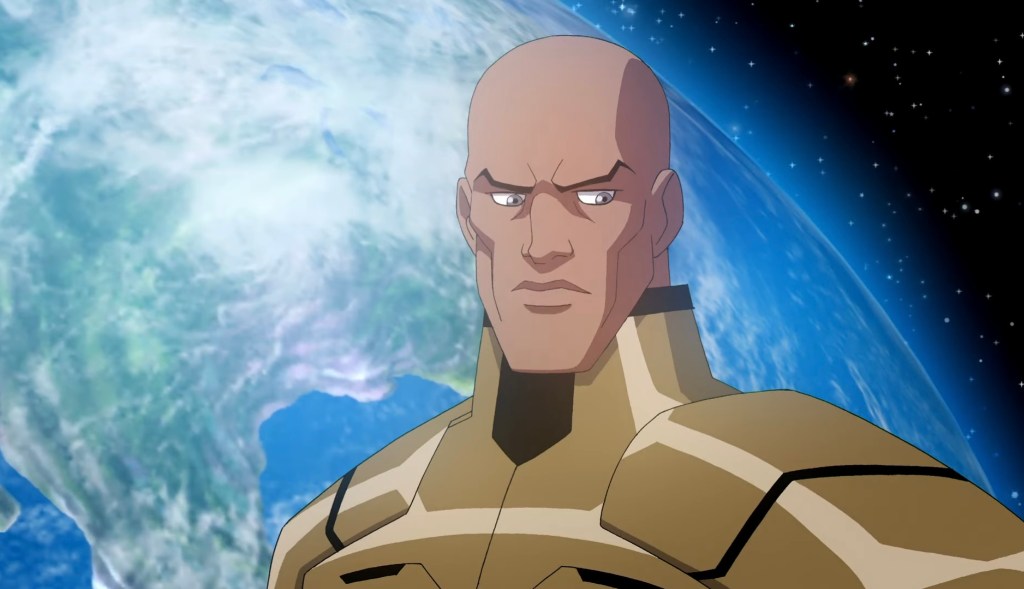
And while Ultraman enacts domination through fear, Superwoman wields it through desire. She distorts the compassionate strength of Wonder Woman into possession and provocation wherein power functions as erotic and authoritarian. She has no use for moral conviction since she commands loyalty by manipulating others’ appetites and insecurities. In her, love—or something like it—is reduced to leverage, and affection becomes a form of conquest. Her relationship with both Ultraman and Owlman encapsulates this dynamic in the comics where she seduces each in turn. And this seduction isn’t driven by fidelity or passion; it’s a means to assert control, to keep them orbiting her pull of ego and cruelty. What makes her so fearsome is her deliberate perversion of intimacy. She derives power from deceit and domination, turning care into coercion and compassion into spectacle.
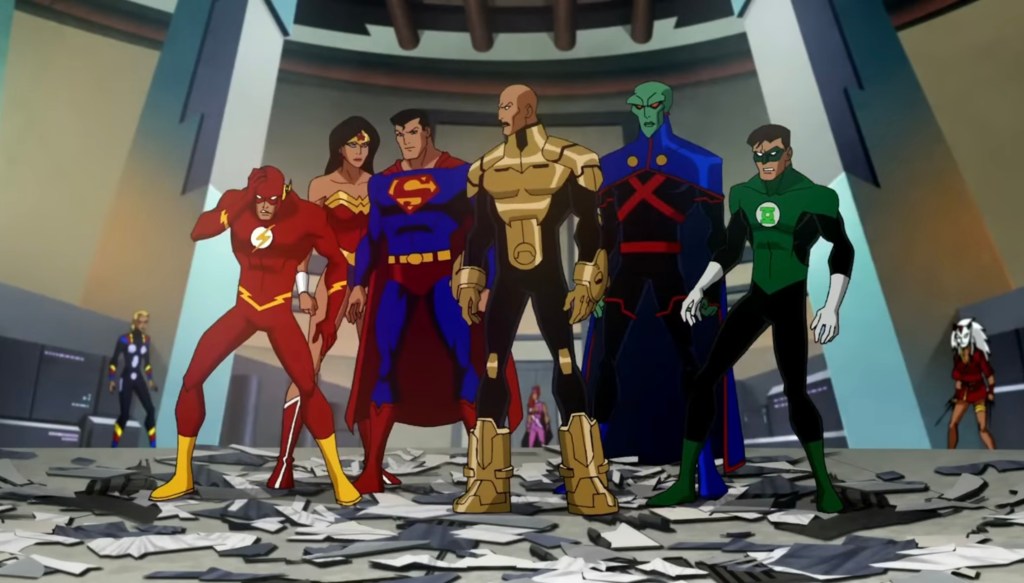
Power Ring depicts the corruption of fear. His ring, unlike Green Lantern’s symbol of will and creativity, enslaves rather than liberates. It speaks to him, dominates him, and feeds upon his anxiety. His every act of aggression is rooted in terror; the desperate need to prove mastery over a power he cannot control. Where the Lantern’s oath is an assertion of inner order [“In brightest day, in blackest night…”], Power Ring’s existence is an admission of inner chaos. He wields power but lacks sovereignty. His weapon of choice is a parasite reflecting the tyranny of his own psyche. Unlike Sinestro, whose corruption springs from authoritarian conviction—the belief that order must be imposed through fear—Power Ring’s evil arises from submission, not control. Sinestro is tyrannical while Power Ring is terrified. The former wields fear as an instrument of dominion, the latter is its instrument as a slave to the dread that sustains his strength. Moreover, his character exposes the inverse of Stoic virtue. The Stoics saw courage as the harmony of reason and passion, the calm governance of self, whereas Power Ring is governed by fear. His spirit is fractured, subject to an external will masquerading as his own. He represents what happens when one’s moral center collapses entirely; when the self becomes host to the very force it fears. In that sense, he is the purest embodiment of vice as psychological disequilibrium: a man so divided that even his source of power becomes a source of torment.
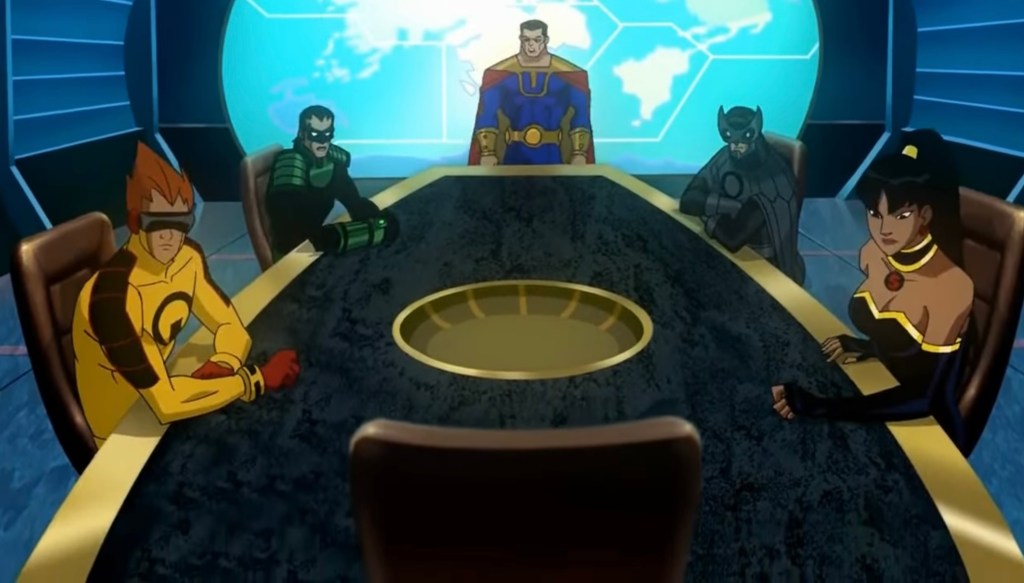
Though only briefly referenced, J’edd J’arkus speaks to the death of empathy itself. J’onn J’onzz channels telepathy as communion. He links minds to share understanding to evince a harmony in the collective soul: a state of moral and emotional attunement in which individual minds and wills are aligned through empathy, reason, and shared purpose. As such, this forms a unified ethical consciousness rather than a collection of isolated selves. On the other side of that, J’edd’s marks spiritual disintegration. His telepathy is about intrusion as opposed to understanding, operant upon weaponizing intimacy and reading minds to dominate rather than to understand. In him, the Martian gift of connection becomes a curse of surveillance. Additionally, his very absence—narratively and conscientiously—signifies a warped presence; a void that speaks to the moral isolation of his world. Early in the film, his death is mentioned without grief or reflection; just a passing detail in a world numbed to loss. But this omission is the point: in a universe where every virtue is inverted, there is no mourning because there is no empathy left to mourn with.

Finally, Johnny Quick manifests the perversion of temperance. The Flash runs on—no pun intended—hope and vitality. What defines him is the catharsis that adversities are not meant to be prevented or all consuming, but honoured. Even though he can time travel, he understands that time [temporal paths and values] shouldn’t—and simply can’t, by virtue of reciprocal causation—undone. Following The Flashpoint Paradox, Barry Allen as The Flash learns that it’s okay to be defined by adversities; but more so defined in the way that a compass defines direction, not the way that a chain defines captivity. Wally West—the version of The Flash in this film and predominantly featured throughout the DC animated universe otherwise—carries that lesson further. He appreciates presence, understanding that velocity without connection is emptiness. Across comics and adaptations, his characterization transforms speed from escape into empathy. He runs to stay in touch with history, not alter it. He seeks to close the distances that grief, guilt, and time impose. His sense of motion becomes communion as a way of feeling the world’s pulse rather than fleeing from it. Through him, the Flash’s legacy evolves from mastery over time to harmony with it.

Which also sets him apart from the Reverse Flash—Eobard Thawne—who never comes to realize that despair is the only outcome when you relive or redo life events without any space for meaning to circulate. Personally, I can appreciate this as I find myself contending with—what feels like a never-ending—repetition [of adversities] without relief because new losses reopen old ones before healing can occur. In that respect, injustice and loneliness reinforce the sense that everything is pointless; and I find myself praying for things—all things—to simply just end. Then, I remember the Dark Flash [as seen in The Flash (2023)] whose character is defined by tirelessly trying to unravel a fixed point and orchestrate a perfect outcome. Each temporal intervention just reopens his first wound, and he keeps running back to the origin instead of forward through its echoes. For me, in everyday life, this entails intrusive thoughts respective to my OCD—constantly revisiting the “what ifs”—and aptly feeling that every new attachment only rehearses the inevitability of loss; to which the adversities stop transforming and start depleting.

Likewise, Johnny Quick purposes speed as compulsion. Driven by arrogance and the terror of insignificance, he doesn’t run toward anything; he runs away. His energy is manic. For him, speed is addiction. Velocity evinces a desperate refusal to pause long enough to face the void within. He’s like the Syndicate’s Sisyphus as a figure condemned to perpetual motion wherein his every triumph immediately collapses into futility. His final act—overexerting his metabolism until it kills him—turns this pathology into a tragic metaphor as his body disintegrates under the very force that defines him, as if the cosmos itself enacts poetic justice for his excess. When Johnny Quick realizes that Batman outwitted him to assume a fatal role [in lieu of The Flash] under a bogus premise of him being faster [than The Flash], he simply smirks: “Good one, mate.” Even in death, he proves consumed by the velocity of his own vice. He represents the soul that mistakes movement for meaning, collapsing from within when it can no longer outrun its own emptiness.
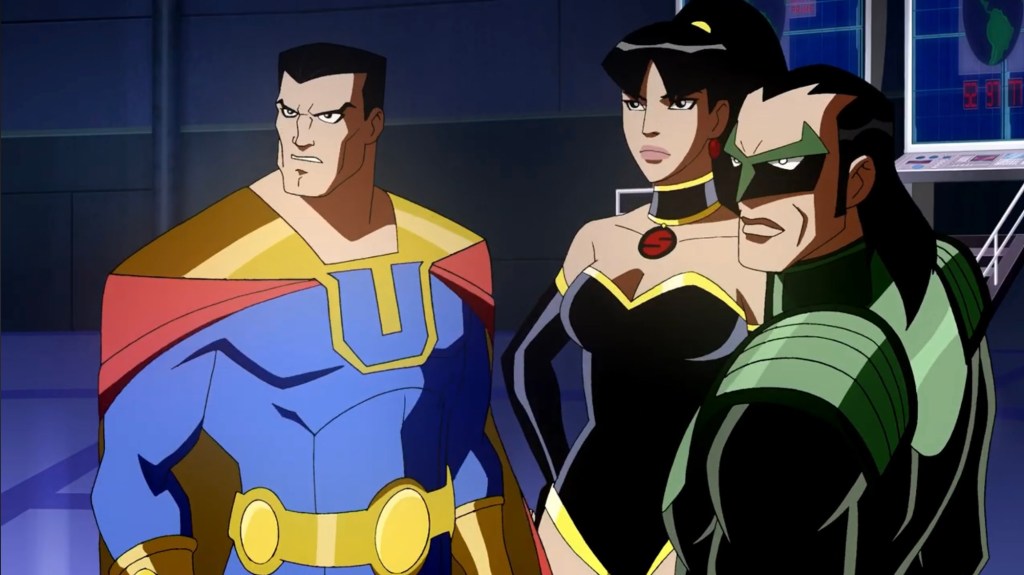
So, the Crime Syndicate come from a world that isn’t exactly a mirror of our own. Their Earth is a metaphysical inversion where every virtue becomes its own caricature. But this inversion also exposes the moral contingency of all worlds. Goodness isn’t the default; it must be continually chosen, created, and renewed. In life as we know it, evil may often prevail in power or perpetuity, but it can’t define meaning unless we let it. The classic hero’s struggle, like the soul’s, is to resist the normalization of corruption rather than eradicate it completely; to keep the light from dimming in a cosmos inclined toward shadow. The parallel worlds in Crisis on Two Earths are less about cosmic dualism than about the fragility of being—or becoming—human; the perpetual effort to make life more than repetition, more than entropy. However they may prove violated or misplaced, I’ve come to accept that my good faith and goodwill don’t make me weak. They enable me to feel, connect, and move through life with wisdom and integrity instead of just force. While the Crime Syndicate depict what happens when the soul collapses inward, the Justice League represent what it means to keep moving forward and persist in faith, justice, and compassion even when the universe seems indifferent. For all its darkness, I think Crisis on Two Earths reminds us that life, like virtue, is something we create through choice. Not the absence of evil, but the refusal to let evil be final.
♫ Title song reference – “Justified & Ancient” by The KLF ft. Tammy Wynette
 Fallen Kittie